
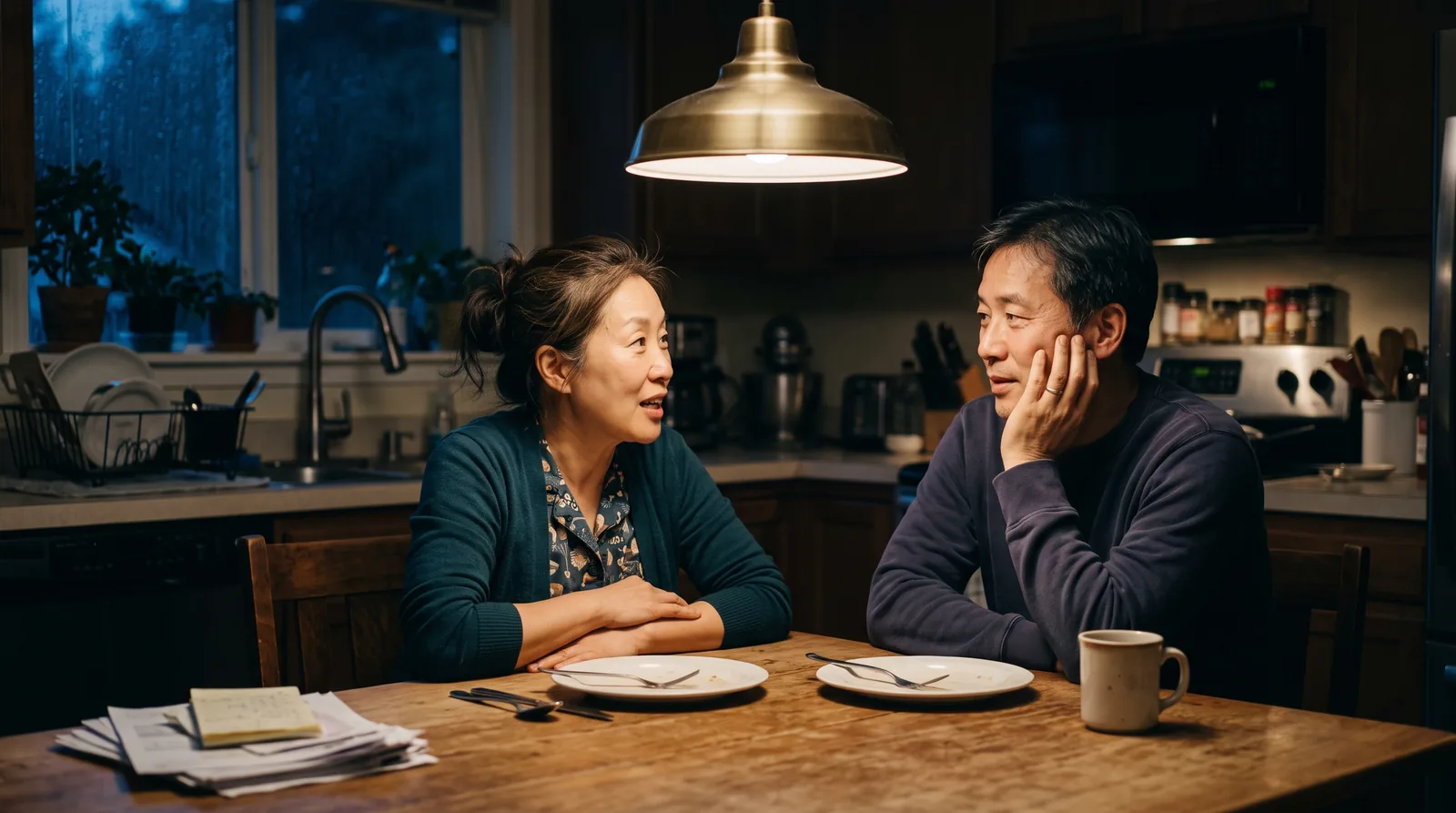
Somewhere out there is an owner who has been thinking about selling for six months and hasn’t said a word about it at home. Not from secrecy exactly. From something more tangled: saying it out loud makes it real, the thinking isn’t finished, and there’s a version of the conversation where the reaction is wrong and the whole fragile idea collapses before it’s been properly considered. So the thinking continues in the truck, in the shower, on the drive between client sites, everywhere except the one table where it actually belongs.
If that’s you, this post has one argument: the dinner-table conversation comes first, before the broker call, before the buyer coffee, before the valuation, and the reasons are practical, not sentimental.
Start with the plainest one. Your spouse has been carrying this business too, for years, whether or not their name appears anywhere on it. They carried the early years when payroll was a prayer. They absorbed the vacations that got interrupted and the dinners that went cold during outages. They know the names of your worst clients and flinch at them. The business has been the third presence in the household for decades, setting the schedule, the mood, and the risk level, and a decision about its future is a decision about their future, made either with them or to them. Owners who announce a nearly-done deal to a blindsided spouse have made the second choice, and it costs them at home in exactly the way you’d expect.
But there’s a colder reason too, one we watch play out in deals: misalignment at home surfaces late and expensively. The seller who gets cold feet in month four of a six-month process, the sudden price re-anchor that came from a kitchen conversation nobody at the table knew about, the closing that stalls because the couple never actually agreed on what happens after. Buyers can’t diligence your marriage, but they feel its state through the deal, and so will you. The time to discover you and your spouse want different futures is two years before a sale, when the discovery costs nothing and can shape the plan, not two weeks before a closing, when it detonates one.
So have the conversation early, when it’s still safely hypothetical, and let it be about the future rather than the transaction. A few questions do most of the work, and none of them mention multiples. What would we want a Tuesday to look like in five years? How much money do we actually need for that, not the fantasy number, the real one? What does the business give you (structure, identity, people) that we’d need to replace, and what does it take from us that we’d get back? Where do we want to live, and does the answer change if the office no longer anchors us here? And the one couples skip at their peril: what are you afraid the answer to all this might be?
Expect the reactions to be uneven, in either direction. Some spouses have been waiting years for this conversation and respond with a relief that tells you everything. Some hear it as instability arriving, especially if the business has always been presented as fine, and need time and more information before the idea feels safe. Both reactions are fair, and neither is the final answer. This is a conversation you’ll have twenty times over a couple of years, in fragments, and the first one only has to open the door, not settle the estate. It also doesn’t commit you to anything, any more than a first conversation with a buyer does. You’re aligning on direction, not signing anything.
A note on the wider family, because it comes up. Adult kids who work in the business deserve a deliberate, early conversation of their own, closer to the front of the line than most owners put them. Adult kids who don’t are a judgment call, made together at that same table, and usually later. Parents, siblings, and the brother-in-law with opinions about private equity can wait until there’s something real to tell. The concentric circles that govern when your team hears the news apply at home too, and your spouse is the innermost ring, alone in it.
What owners report afterward, almost universally, is that the conversation went better than the version they’d been rehearsing in the truck, and that carrying it alone had been its own quiet tax. One of them told us the specifics: he’d spent most of a year building the case in his head, complete with counterarguments for objections that never came, and when he finally laid it out over an unremarkable Wednesday meatloaf, his wife listened all the way through, was silent for a moment, and said, “I’ve been hoping you’d say that since your surgery.” They sold eighteen months later, on a plan they built together, and he says now that the deal really closed at that table. Everything after was paperwork.